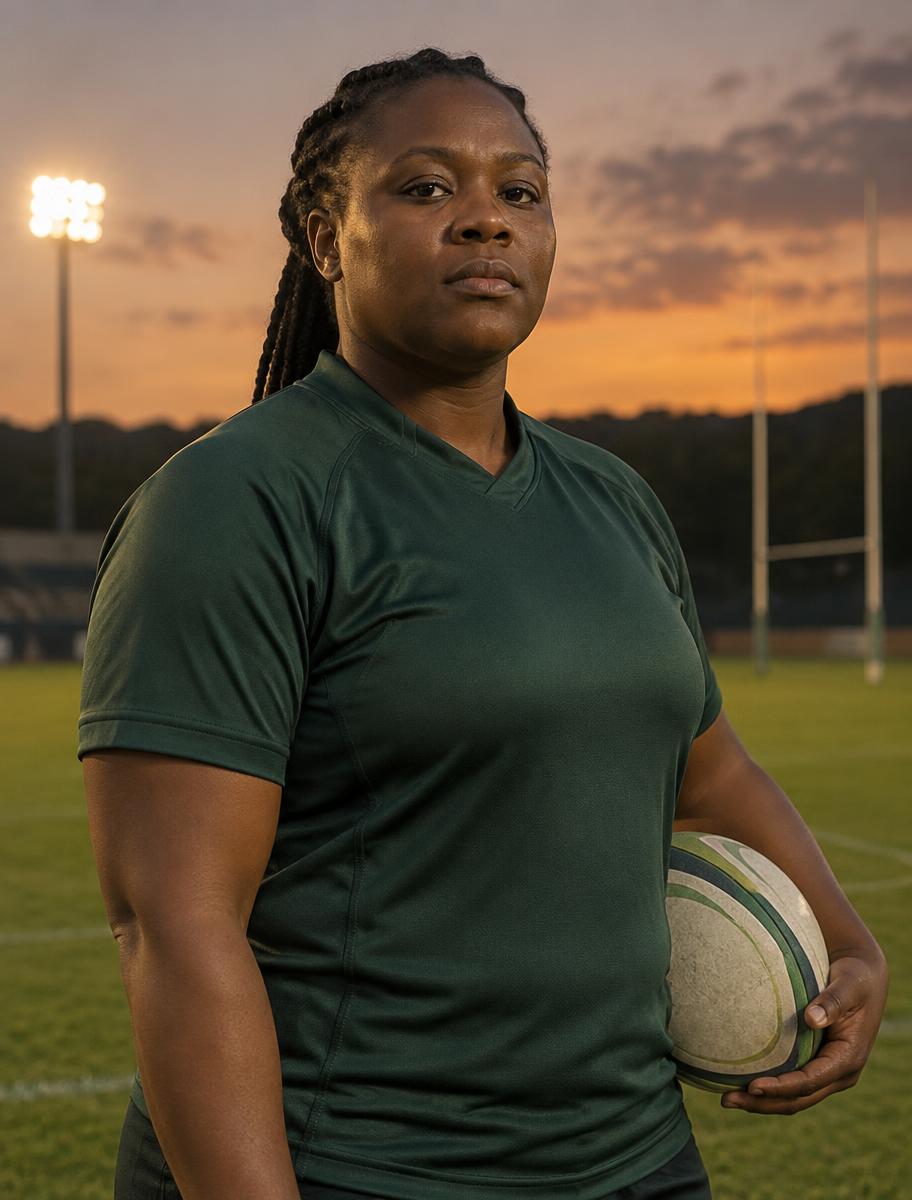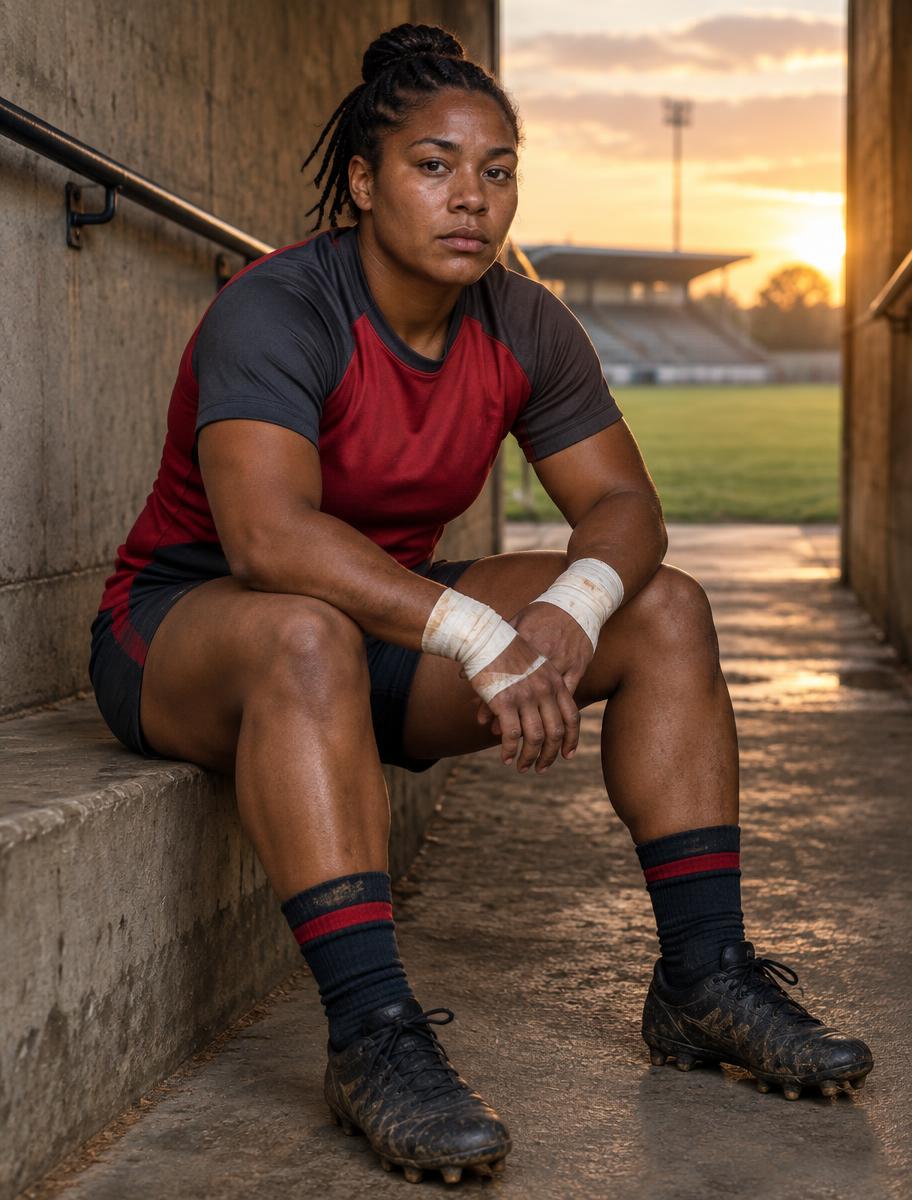
From athletics to rugby
Nadine Roos did not begin her sporting career with rugby.
Growing up in Pretoria, she competed in athletics and developed as a hurdler before receiving a bursary to study at the University of Pretoria. She also played netball and later became involved in CrossFit. Rugby entered her life while she was studying, eventually becoming the sport in which she would build her international career.
Roos has spoken about sport being an important part of her life from a young age. She was raised by her grandmother after being abandoned by her mother as a baby, and has credited her grandmother and the people around her with helping shape her determination and work ethic.
Her athletic background would later become one of her greatest advantages on the rugby field.
A Springbok Sevens career that began in 2016
Roos made her international rugby sevens debut for South Africa at the Dubai tournament in 2016, as part of the 2016–17 World Rugby Women’s Sevens Series. She quickly became a regular member of the national programme.
She went on to represent South Africa at the 2018 Rugby World Cup Sevens and the 2018 Commonwealth Games, gaining experience at major international tournaments early in her career.
Roos was also part of the team during the rebuilding of South African women’s Sevens after the programme returned to the international stage.
At the 2022 Rugby World Cup Sevens in Cape Town, she became one of South Africa’s standout attacking players. Roos scored four tries against Colombia in a 27–0 placement victory, becoming only the fourth woman to score four tries in a Rugby World Cup Sevens match.
Her performances helped establish her as one of the team's most dangerous attacking options.
A player who can do more than one job
One of Roos's defining characteristics is her versatility.
SA Rugby lists her as a utility back. At Test level in 15-a-side rugby, she has played in several backline positions, including scrum-half, fly-half, wing and fullback.
That adaptability is particularly valuable in Sevens.
With only seven players on the field and large amounts of space to cover, Sevens players need to be comfortable performing different tasks. A player must be able to attack space, defend in open field, pass accurately, make decisions under pressure and cover significant distances.
Roos's athletic background gives her an obvious advantage in that environment.
The World Rugby preview for the Paris Olympics highlighted her ability to cover large distances and described the energy she brought to the team. The 2024 Olympic media guide also identified her as South Africa’s leading scorer on the SVNS circuit that season, with 22 tries and 178 points.
Her game is therefore not based simply on speed. Her value comes from combining pace, fitness, attacking instincts and positional flexibility.
From Sevens to 15-a-side rugby
Roos has also become an important figure in the Springbok Women, South Africa's 15-a-side national team.
She made her Test debut in 2021 against France in Vannes, initially playing on the wing. Since then, she has appeared in multiple positions in the backline.
Her ability to move between the two formats illustrates the overlap between Sevens and 15-a-side rugby in South Africa.
The skills developed in Sevens — particularly acceleration, handling, spatial awareness and decision-making — can be valuable in the longer format. At the same time, playing 15-a-side gives Roos experience in a more structured tactical environment.
She was part of the Springbok Women squad that reached the quarter-finals of the 2025 Rugby World Cup, another major milestone in her international career.
The road to Paris
One of the most important moments of Roos's career came in 2023, when South Africa finally qualified for the Olympic Games.
South Africa had previously won the African regional qualification tournaments for Rio 2016 and Tokyo 2020, but the team did not compete at either Games because of South African Olympic selection rules. The 2023 qualification tournament in Tunisia gave the Springbok Women’s Sevens another opportunity.
Roos played a central role in that campaign. She scored nine tries and kicked 10 conversions, contributing 37 points during South Africa's opening three pool victories and scoring the team's first try in the final against Kenya.
South Africa won the final 12–7, securing the country’s first-ever Olympic place in women’s rugby sevens.
For Roos, the qualification was particularly meaningful. She had been part of the South African programme during previous attempts to reach the Olympics. In 2024, she finally had the opportunity to represent her country at the Games.
South Africa eventually finished 11th in Paris, but the tournament itself represented a historic first for the programme.
A leader in the rebuilding Springbok Sevens
Roos's experience became increasingly important as South Africa rebuilt its Sevens programme.
The team lost its HSBC SVNS core status at the end of the 2024 season. In 2025, South Africa finished second across the three Challenger Series events, while the new 2026 competition structure created a different route back towards the top level.
South Africa began the 2026 campaign in HSBC SVNS 3, where the team won the Dubai tournament and earned promotion to SVNS 2.
Roos was captain for the campaign. She then led South Africa during the SVNS 2 tournaments in Nairobi, Montevideo and São Paulo.
South Africa finished third overall in SVNS 2, securing a place in the 2026 HSBC SVNS World Championship alongside the leading teams from the top division and the other SVNS 2 qualifiers.
Her leadership was particularly important during a season in which the squad had to adapt to a new competition structure and a demanding schedule.
A key player even when injured
Roos's importance to the team became particularly clear when injury forced her out of the World Championship.
After the final SVNS 2 tournament in São Paulo, SA Rugby confirmed that Roos had suffered a knee injury and was ruled out for the remainder of the 2026 season.
She therefore missed the first World Championship tournament in Hong Kong, where South Africa finished 12th. The team then recovered to finish ninth in Valladolid before ending the campaign in 11th place in Bordeaux.
Her absence created opportunities for other players. Ayanda Malinga took over the captaincy in Hong Kong, while younger members of the squad were asked to assume greater responsibility.
Owami Mohuli, one of the emerging players in the squad, described Roos as a sporting idol and spoke about how much the younger players could learn from her career.
That reaction from a younger teammate illustrates Roos's influence beyond her individual statistics.
A decorated player
Roos has received recognition for her performances in both formats.
She was named SA Rugby Women's Player of the Year in 2022, 2024 and 2025. She was also named Springbok Women’s Sevens Player of the Year in 2025.
Her 2023 Sevens campaign included one of the most memorable individual performances of the Challenger Series. At the tournament in Stellenbosch, Roos scored five tries against Thailand as South Africa won 38–0.
She then continued to contribute during the knockout stages as South Africa won the tournament and secured promotion to the World Rugby Sevens Series.
These performances underline one of her biggest strengths: the ability to turn open space into points.
Why Nadine Roos matters to South African Sevens
Roos represents several stages of the development of women's rugby in South Africa.
She began as a multi-sport athlete, moved into rugby while studying, became an international Sevens player, played at multiple World Cups, helped South Africa qualify for its first Olympic Games and later became captain of the national Sevens team.
She has also successfully crossed between Sevens and 15-a-side rugby.
That versatility matters for South Africa because the country's women's rugby programmes are increasingly connected. Players can develop in one format and use those skills in another, while experienced internationals can provide leadership across different national teams.
For younger players, Roos also provides a visible example of what a career in women's rugby can look like.
The next chapter
At 30, Roos remains an important figure in South African women's rugby, although a knee injury ruled her out for the remainder of the 2026 Sevens season.
Her career has already included major milestones: a decade of international Sevens, World Cups, Commonwealth Games, Olympic rugby and major success in African competition.
Her role has also changed as the programme has developed.
She is no longer simply one of South Africa's promising young backs. She has become one of the experienced players whose performances and leadership have helped shape the national programme, while her career between Sevens and 15-a-side rugby has given her a broader role in South African women's rugby.
That combination of athletic ability, versatility and experience makes Nadine Roos one of the defining figures of South African women's Sevens — and an important part of the programme as the Springbok Women’s Sevens continue working towards a return to the highest level of international competition.
Sources
- SA Rugby — Nadine Roos official player profile.
SA Rugby — Springbok Women’s Sevens official team page.
World Rugby — Nadine Roos hoping to make a statement for gran and South Africa at Rugby World Cup Sevens 2022.
World Rugby — South Africa women qualify for Paris 2024 Olympic Games.
SA Rugby — Roos: We are not going to Paris to see the Eiffel Tower.
World Rugby — South Africa: Rugby Sevens Olympic Games Paris 2024 fact file.
World Rugby — Rugby World Cup Sevens 2022 team profiles and statistics.
SA Rugby — Settled Springbok Women’s Sevens squad selected for Europe, 21 May 2026.
SA Rugby — Afrika names Bok Women’s Sevens squad for South America, 13 March 2026.
SA Rugby — Mpupha and Webb return for Bok Women’s 7s HK trip, 12 April 2026.
SA Rugby — Afrika applauds growth and grit of Springbok Women’s Sevens, 30 March 2026.