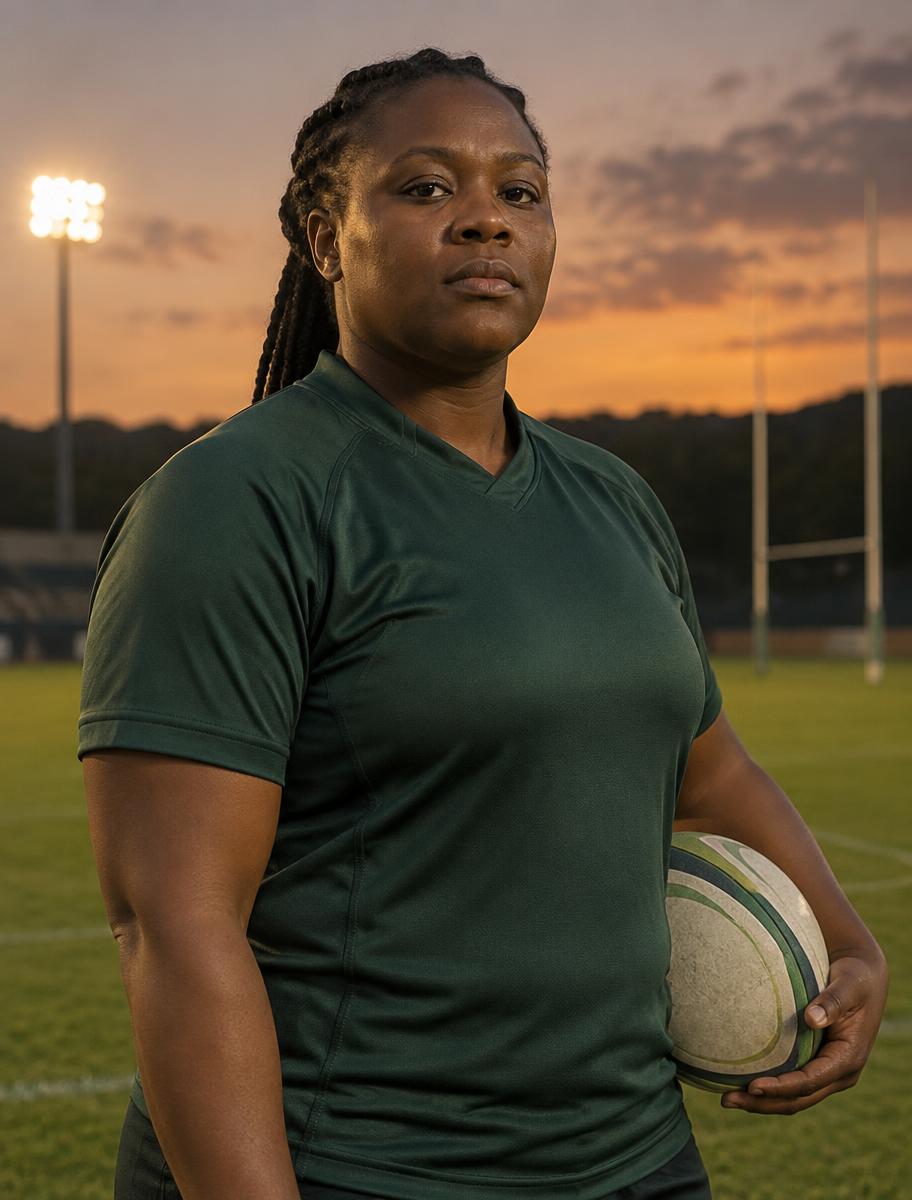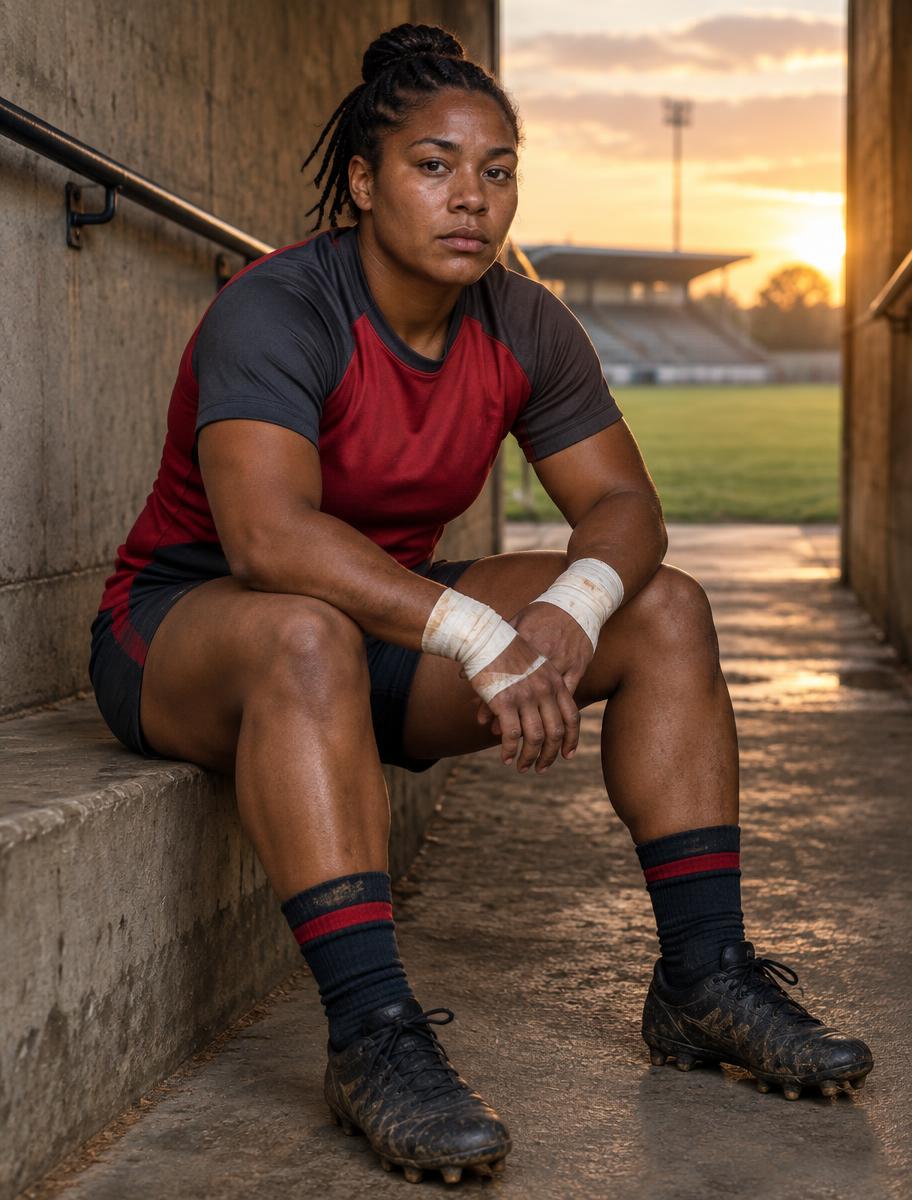
From netball to rugby
Anathi Qolo’s route into rugby was not a conventional one.
Born in Queenstown and raised in Mdantsane in the Eastern Cape, Qolo initially played netball rather than rugby. Her introduction to rugby came through school and Border rugby development programmes, where she was encouraged to try the sport. Former Springbok Women captain Mandisa Williams was among the people who helped convince her that rugby could become a serious career.
Qolo attended Sandisiwe High School in Mdantsane and became part of the Border Youth Training Centre.
Her development included the FNB U16 and U18 Girls Weeks, giving her experience in representative rugby before she moved into the senior provincial game.
It was the beginning of a career that would eventually take her from the Eastern Cape to the Springbok Women.
Making the step into senior provincial rugby
Qolo made her senior debut for the Border Ladies in 2018.
That step was important because provincial rugby provided her with regular senior competition and an opportunity to develop her skills against more experienced players.
A year later, she moved to Pretoria and joined the Bulls Daisies.
The move proved to be a major turning point.
Qolo became part of a programme that would make history in 2023 when the Bulls Daisies became South Africa’s first professional women’s rugby team. The players were given professional contracts, allowing them to focus on rugby as a full-time career.
The professional environment gave Qolo the opportunity to develop in a high-performance setting while playing alongside and against some of South Africa’s leading players.
By 2025, she had already made 54 appearances for the Daisies, according to the team’s announcement of her Springbok captaincy that year.
Finding her position
Qolo's primary position is lock.
At 175 cm and around 80 kg, she is not the largest player on the rugby field, but mobility is an important part of her game. SA Rugby describes her as a lineout specialist and mobile utility forward.
The lock position requires much more than simply being tall.
Locks are central to the lineout, where they compete for possession and help provide the team with attacking and defensive options. They also contribute to the scrum, tackle, carry and support play around the field.
Qolo’s ability to combine lineout work with mobility has become one of her defining characteristics.
She has also demonstrated positional flexibility. When she made her Springbok Women debut in 2024, she was selected at No. 8, rather than at lock.
That versatility has helped make her useful to coaches looking for forwards who can perform more than one role.
The Bulls Daisies changed her ambitions
Qolo has spoken openly about the impact the Bulls Daisies had on her career.
When she arrived in Pretoria, the idea of playing for the Springbok Women became much more tangible. In an interview ahead of the 2026 Super League 1 final, she explained that it was only after joining the Daisies that she really started wanting to play for South Africa. The environment pushed her to believe that such a career was possible.
The professionalisation of the Daisies was significant for Qolo and for South African women’s rugby more broadly. In 2023, the team became the country's first professional women's rugby side, with players receiving contracts that allowed them to concentrate on rugby full-time.
Qolo has described the professional environment as a major advantage. Compared with players who have to balance rugby with other employment, professional players can devote more time to training, analysis, preparation and recovery.
For Qolo, that environment helped change not only her physical preparation but also the way she thought about rugby.
A Springbok debut in 2024
Qolo received her first call-up to the Springbok Women in 2024.
She was one of several Bulls Daisies players included in South Africa’s squad for the European tour that year. The opportunity came after she had established herself at provincial level.
Her Test debut came against Spain in Valladolid on 23 March 2024.
Qolo started the match at No. 8, alongside a South African pack that included several experienced internationals. South Africa won the Test, giving her a successful introduction to international rugby.
The debut was the culmination of several years of provincial development.
She had gone from school and age-group rugby in the Eastern Cape to Border Ladies, then to the Bulls Daisies and finally to the Springbok Women.
From new cap to national captain
Qolo’s international rise was remarkably quick.
Only a year after her Test debut, she was selected to captain the Springbok Women at the 2025 Rugby Africa Women’s Cup in Madagascar.
The appointment made her the 11th woman to captain South Africa in a Test match since the Springbok Women played their first Test in 2004.
She led South Africa against Uganda, Kenya and Madagascar as the team successfully defended its African title. Her leadership role continued to be recognised in 2026, when she was again named captain of the Springbok Women for the Rugby Africa Women’s Cup in Nairobi.
South Africa went on to win the tournament for a fifth consecutive time, beating Kenya 35–20 in the final.
Qolo’s international captaincy is notable because she reached the role relatively early in her Test career. It also reflects the importance of leadership developed outside the national team, particularly through provincial rugby.
Leading the Bulls Daisies in 2026
Qolo's leadership role expanded further in 2026.
She became captain of the Bulls Daisies during the 2026 Pick n Pay Women's Super League 1 season, taking over after the death of former captain Lusanda Dumke in 2025. Qolo has spoken about how difficult that transition was and how much Dumke meant to the team.
The Daisies entered the 2026 final having won all seven of their matches.
Qolo then led the team out at Loftus Versfeld against the Sanlam Boland Dames. The Daisies won 36–15, securing their fourth consecutive top-flight provincial title.
For Qolo, the victory was both a sporting achievement and a tribute to Dumke.
It also reinforced her position as one of the established leaders of the South African provincial game.
A leader of the next generation
Qolo’s story is particularly relevant because her career reflects the development of the women’s rugby pathway in South Africa.
She did not begin as a professional player.
She entered rugby through school and regional development programmes, progressed through age-group representative rugby, played for Border Ladies and then moved to the Bulls Daisies. The professionalisation of the Daisies gave her an environment in which she could develop further, eventually earning a Springbok call-up.
Her career illustrates how different parts of the South African system can connect.
SA Rugby has been expanding women’s age-group programmes and national development structures, while provincial competitions provide senior players with regular high-level rugby. Qolo’s career is one example of how a player can move through several of those environments before reaching the national team.
The pathway is not necessarily a single fixed ladder. Players can also move through Sevens, university rugby, age-group teams and national development camps before establishing themselves internationally.
Her role in the Springbok Women
By September 2026, Qolo had established herself as a regular member of the Springbok Women squad.
SA Rugby lists her as a lock, with 11 Test caps, and continues to describe her as a lineout specialist and mobile utility forward.
She was also part of the Springbok Women squad that competed at the 2025 Women’s Rugby World Cup. Qolo made her tournament debut against France in the pool stage and South Africa went on to reach the quarter-finals for the first time in the team’s history.
Her international experience has therefore expanded considerably in a relatively short period.
At the same time, she continues to play an important role in the domestic game, giving her experience of both provincial competition and Test rugby.
More than a rugby player
Qolo’s story also reflects the wider changes taking place in South African women’s rugby.
She has spoken about the importance of professional opportunities for women. The Bulls Daisies’ transition to a professional model has allowed players to devote themselves fully to training and preparation, something that remains unavailable to many other provincial teams.
Qolo has expressed the hope that the success of the Daisies can encourage other South African teams and franchises to move towards professional structures.
Her argument is straightforward: greater professional investment gives more women the opportunity to dedicate themselves to rugby and develop their potential.
That makes her role larger than that of an individual player.
She is also part of a generation demonstrating what can become possible when talented young women have access to better coaching, regular competition and professional support.
From Border to the Springbok jersey
Anathi Qolo’s career is a useful example of how a South African women’s rugby player can progress through the domestic system.
Her journey began in the Eastern Cape, where school and Border development programmes introduced her to rugby. She represented Border at age-group level, made her senior debut for the Border Ladies in 2018 and moved to Pretoria the following year.
At the Bulls Daisies, she developed into an established provincial forward and eventually became captain.
In 2024, she earned her first Springbok cap.
In 2025, she captained South Africa at the Rugby Africa Women’s Cup and became the 11th Test captain in the history of the Springbok Women.
In 2026, she led both the Springbok Women and the Bulls Daisies, captaining the latter to their fourth consecutive Super League 1 title.
The journey is still continuing.
At 28, Qolo is now one of the experienced players in the Springbok Women squad, while remaining closely connected to the provincial game that helped build her career.
Her story demonstrates why domestic rugby matters. The next international player does not necessarily begin her career knowing she will become a Springbok.
Sometimes she begins on a school netball court, is persuaded to try rugby, discovers a new sport, finds a provincial team and gradually develops the confidence to believe that the green and gold might one day be possible.
For Anathi Qolo, that journey has already taken her from the Eastern Cape to the international stage.
Sources
- SA Rugby — Anathi Qolo official Springbok Women profile
SA Rugby — Qolo to lead Springbok Women to Rugby Africa Women’s Cup, 18 May 2026
SA Rugby — Magnificent Isuzu Bulls Daisies make it four in a row, 4 April 2026
Vodacom Bulls — Anathi Qolo to lead Springbok Women to Madagascar, 19 May 2025
Vodacom Bulls — From Eastern Cape netball courts to Loftus captaincy: Qolo’s story of grit and belief
SA Rugby — Springbok Women official team page
World Rugby — Women’s Rugby World Cup 2025 match records
SABC Sport — Anathi Qolo captains Springbok Women targeting Rugby Africa Women’s Cup defence, 15 May 2025.
MyPlayers — From Mdantsane to Madagascar: Anathi Qolo’s Journey to Springbok captaincy.