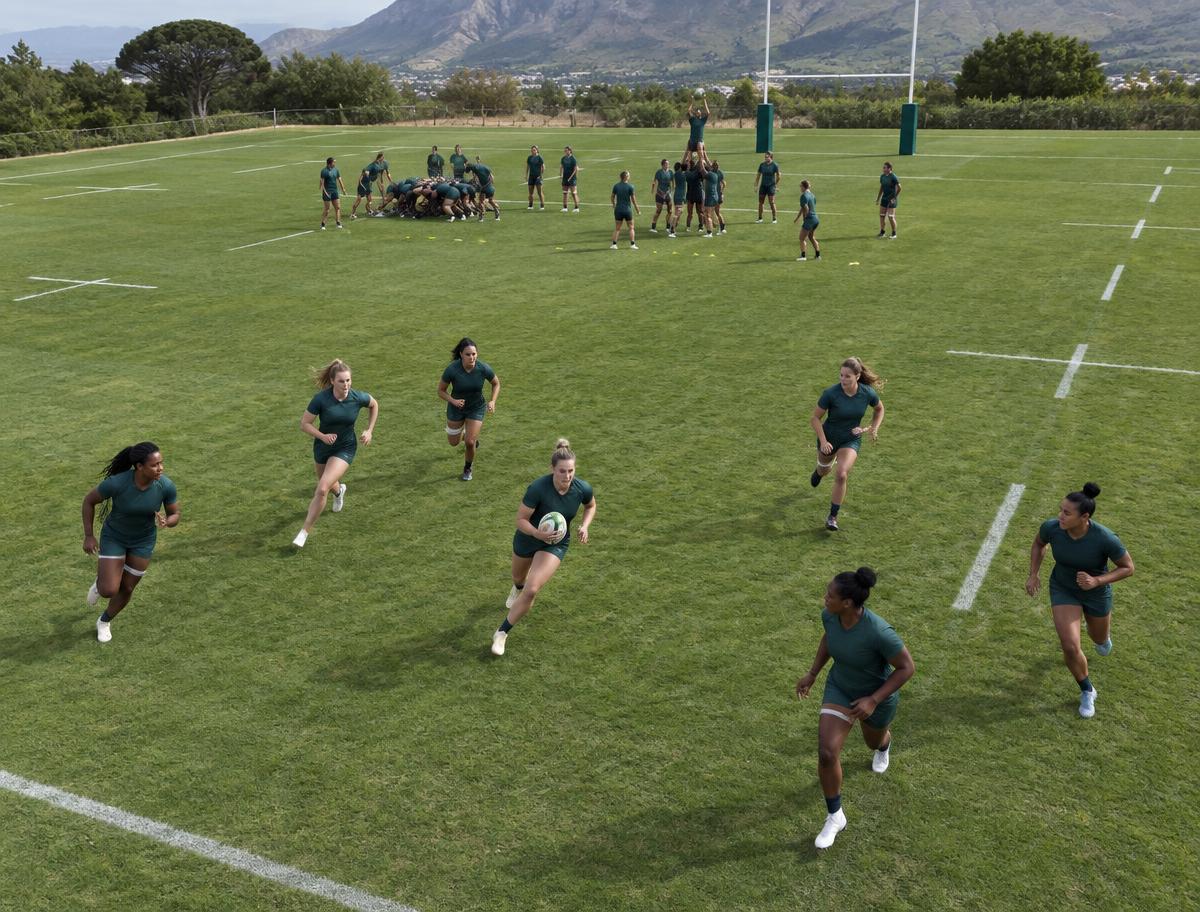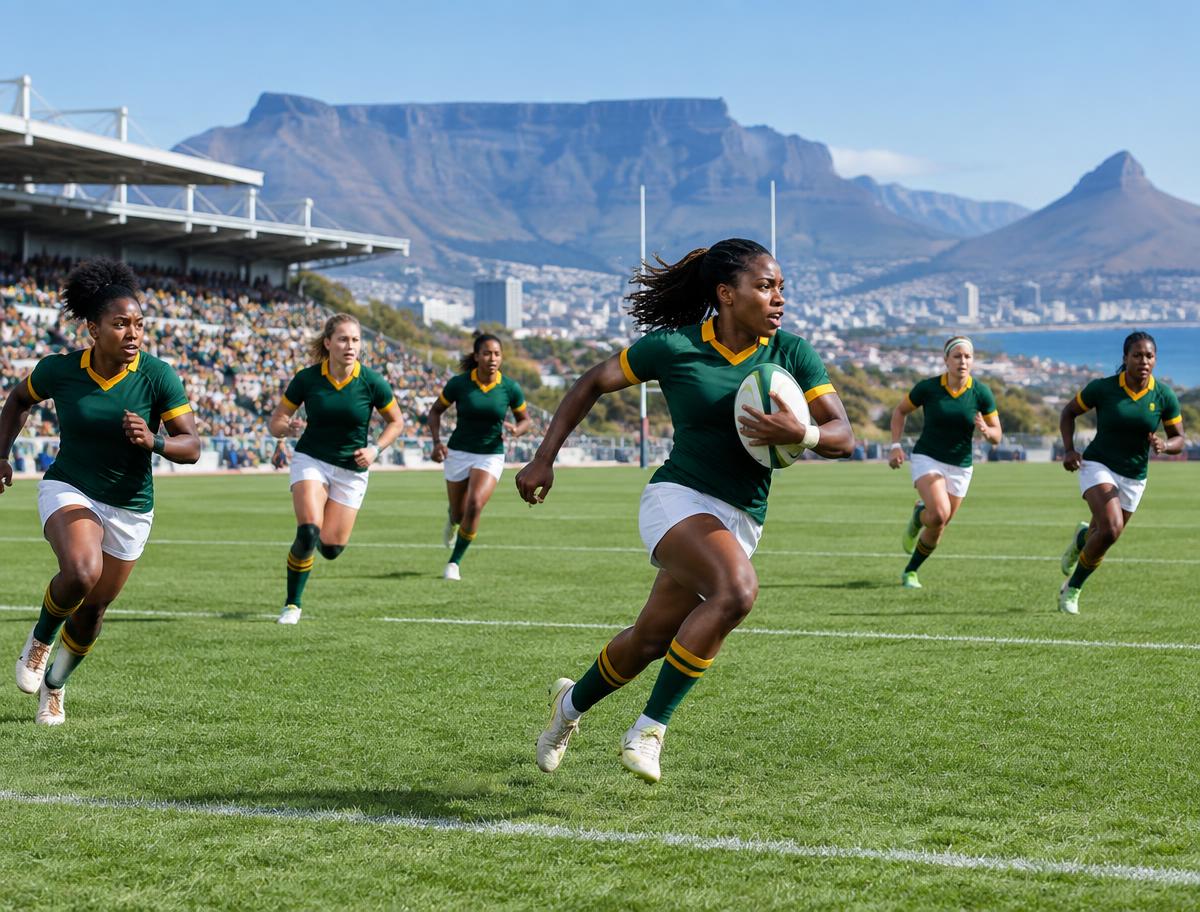
Who are the Springbok Women’s Sevens?
The Springbok Women’s Sevens are South Africa’s national team in rugby sevens, the fast-paced version of rugby union played with seven players per side.
Although the team shares the Springbok name with the national 15-a-side side, it is a separate programme with its own squad, coaching staff and international schedule. Players can, however, move between the two programmes, while some athletes also combine sevens with provincial 15-a-side rugby.
The team is currently coached by former Springbok Sevens star Cecil Afrika, while Nadine Roos is listed by SA Rugby as captain. Roos is one of South Africa’s most experienced sevens players and also has extensive experience in the 15-a-side game. She represented South Africa at the 2024 Paris Olympics and has played at both the Rugby World Cup Sevens and the 15-a-side Rugby World Cup.
South Africa have a long history in women’s sevens. The Springbok Women’s Sevens first appeared at the Rugby World Cup Sevens in 2009 and have also represented the country at the Olympic Games, including Paris 2024. They were Rugby Africa Sevens champions in 2022, 2023, 2024 and 2025.
Why is the 2026 season different?
The international sevens calendar was significantly redesigned for 2026.
Instead of one traditional World Series, World Rugby introduced a three-division structure. The idea is to create a clearer pathway between regional competitions, the international Challenger level and the world’s leading teams.
The three levels are:
- HSBC SVNS 1 — the top division, featuring eight men’s and eight
- women’s core teams.
HSBC SVNS 2 — the second tier, featuring six teams per gender.
HSBC SVNS 3 — a third-tier competition involving eight men’s and eight women’s teams, with qualification coming through regional competitions.
The season then culminates in the HSBC SVNS World Championship Series, bringing together the top 12 teams.
This structure means that a team does not necessarily have to start the season among the world’s elite to reach the World Championship.
That was exactly what happened to South Africa in 2026.
South Africa’s route through the 2026 season
The Springbok Women’s Sevens began the 2026 international season in HSBC SVNS 3 in Dubai in January.
South Africa won the tournament without losing a match, defeating Argentina 12-5 in the final. The victory also secured promotion to SVNS 2.
The next stage consisted of three SVNS 2 tournaments in Nairobi, Montevideo and São Paulo.
South Africa performed strongly enough across the three events to finish in the top four overall and qualify for the season-ending World Championship. They secured their qualification in Montevideo in March by guaranteeing a top-four overall position in the SVNS 2 standings, despite finishing third at the tournament itself.
That meant South Africa had climbed from the third tier to the season-ending World Championship in a matter of months.
It is one of the clearest examples of how the new SVNS structure is supposed to work.
The HSBC SVNS World Championship
The World Championship is the final stage of the 2026 season.
The top 12 women’s teams — the eight teams from SVNS 1 plus four qualifiers from SVNS 2 — competed across three tournaments in Hong Kong, Valladolid and Bordeaux. Results from the three events determined the final World Championship standings.
For South Africa, the campaign began in Hong Kong in April.
The team then travelled to Valladolid in Spain in May. South Africa finished ninth overall at the tournament, beating Argentina and Brazil in their final two matches.
The final tournament took place in Bordeaux, France, in June. South Africa lost both of their opening matches against France and New Zealand and ultimately finished 11th in Bordeaux.
The campaign nevertheless gave the squad valuable experience against teams competing regularly at the highest level of international sevens.
What makes rugby sevens different?
For newcomers, the easiest way to understand the Springbok Women’s Sevens is to remember that seven players play on a full-size rugby pitch.
With fewer players covering the same amount of space, there is much more room to attack. Speed, acceleration, passing and one-on-one skills become particularly important.
Possession also matters enormously. A team that can retain the ball and force defenders to make repeated tackles can quickly create gaps.
Set pieces are still part of the game, but there are fewer players involved in scrums and lineouts. Matches are also much shorter than traditional 15-a-side Tests.
The result is a game that can change extremely quickly. A team can concede a try and immediately respond with one of its own, while a single missed tackle can lead to a long-range score.
Who should you watch?
Nadine Roos is one of the most recognisable players in the programme. She has represented South Africa in both sevens and 15-a-side rugby and has played in several positions across the backline. However, Roos missed the remainder of the 2026 season after suffering a knee injury.
The 2026 squad has also included players with different levels of international experience. At the Hong Kong tournament, for example, experienced players such as Zintle Mpupha and Ayanda Malinga were joined by uncapped players including Jané Mulder and Owami Mohuli.
That mixture is an important part of the programme. Sevens requires a particularly demanding combination of speed, fitness, ball skills and decision-making, and international tournaments provide an opportunity for emerging players to develop those qualities.
Where does the team go from here?
The 2026 season showed both the potential and the challenge facing the Springbok Women’s Sevens.
South Africa successfully climbed from SVNS 3 through SVNS 2 and reached the World Championship. That achievement demonstrated that the new international structure can provide a route back towards the top level for a team that is rebuilding.
The programme’s longer-term objective is to establish South Africa among the world’s leading sevens nations again. The team had previously become a core SVNS side for the 2023/24 season after winning both Challenger Series tournaments in Stellenbosch in 2023, but lost that core-team status at the end of the 2024 season.
For supporters, that makes the Springbok Women’s Sevens an especially interesting team to follow. The programme combines experienced internationals with emerging talent, while the new SVNS structure gives South Africa a clear competitive route back to the top.
Sources
- SA Rugby — Springbok Women’s Sevens official team page.
World Rugby — HSBC SVNS 2026 calendar and competition structure.
World Rugby — HSBC SVNS World Championship Series 2026.
World Rugby — South Africa win HSBC SVNS 3 Dubai 2026.
SA Rugby — Bok Women’s Sevens book World Champs tickets.
SA Rugby — Settled Springbok Women’s Sevens squad selected for Europe.
SA Rugby — No champagne for Springbok Women’s Sevens in Bordeaux.
SA Rugby — Bok Women’s Sevens take 2026 lessons to heart.
SA Rugby — Onwards and upwards for Bok Women’s Sevens.