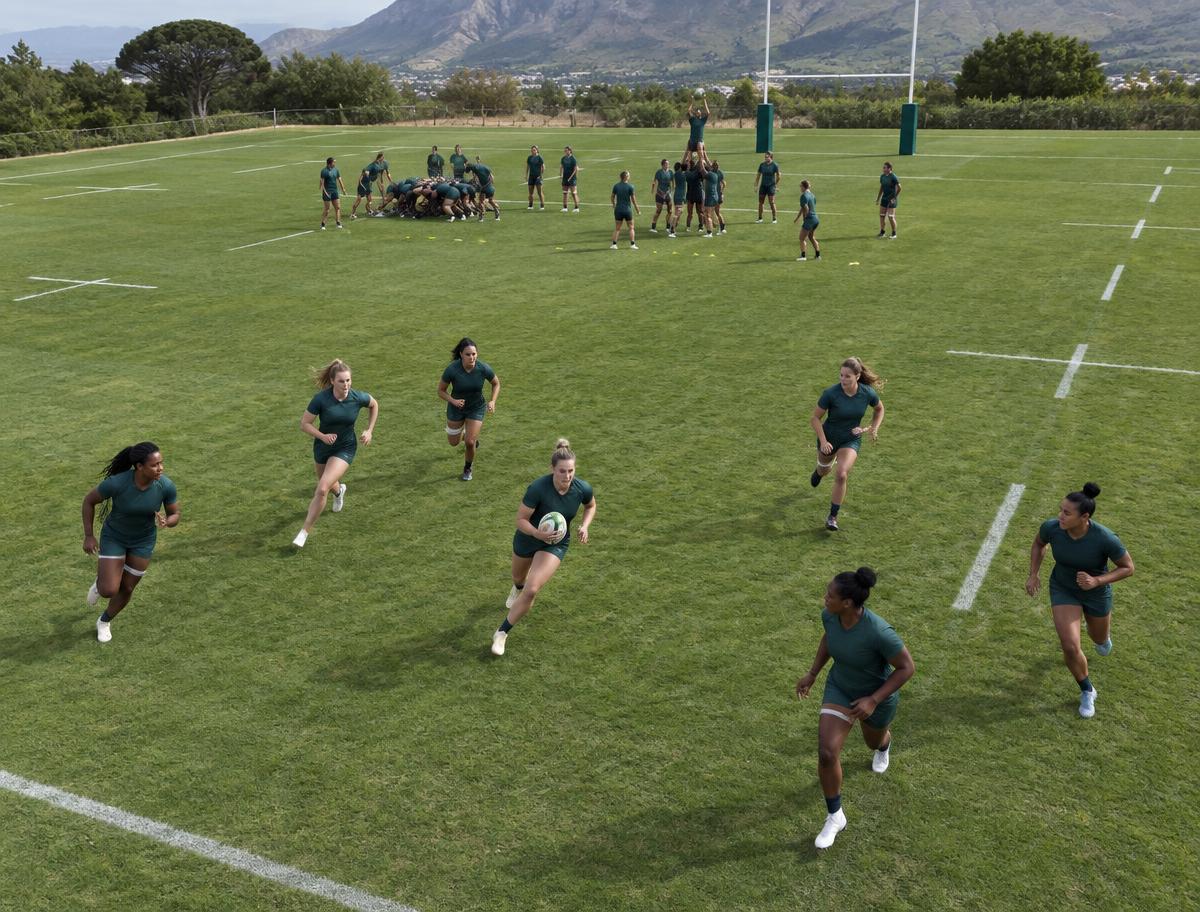
Two versions of the same game
If you have watched rugby union, you may already know the basic idea: two teams compete to carry, pass and kick the ball towards the opposition's try line and score more points than their opponents.
But there are two major versions of the sport played at international level: traditional 15-a-side rugby and rugby sevens.
The fundamental laws are the same, but sevens is designed to be faster and more open. There are only seven players on each team instead of 15, while the match is dramatically shorter.
These changes have a major effect on the way the game is played. In 15-a-side rugby, teams can use numbers and structured formations to control space. In sevens, every player has much more ground to cover, making speed, fitness, decision-making and one-on-one skills particularly important.
Seven players vs 15
The most obvious difference is the number of players.
In traditional rugby union, each team can have 15 players on the field. The squad also contains replacements, with up to eight replacements permitted for international matches under the standard laws.
In rugby sevens, each team has seven players on the field. Under the current World Rugby sevens laws, teams can nominate and use up to five replacements in international matches.
The positions are also generally less specialised in sevens.
A 15-a-side team has dedicated props, a hooker, locks, flankers, a number eight, a scrum-half, fly-half, centres, wings and a full-back. Sevens still has positional structure, with three forwards and four backs, but the smaller number of players means athletes have to perform a much wider range of tasks.
A sevens player may have to defend, carry the ball, pass, kick and support attacks over large areas of the pitch during the same match.
80 minutes vs 14 minutes
The difference in match length is enormous.
A standard 15-a-side rugby match lasts up to 80 minutes, divided into two halves of no more than 40 minutes.
A standard sevens match lasts only 14 minutes, with two seven-minute halves and a half-time interval of no more than two minutes. A competition final can last up to 20 minutes, with two 10-minute halves.
That does not mean sevens is easier.
Quite the opposite. Because there are only seven players covering a full-size rugby pitch, players have to cover large amounts of ground at high intensity. A sevens tournament can also require teams to play several matches over a short period, sometimes on the same day.
The shorter format makes every possession important. With so little time on the clock, there is much less opportunity to recover from mistakes.
The same pitch, much more space
One of the biggest differences is something you can see immediately when watching the two formats.
Sevens is normally played on a full-size rugby pitch, just like 15-a-side rugby. But there are fewer players occupying that space.
Imagine removing eight players from each side without making the pitch smaller. Suddenly there are much larger gaps between defenders.
That changes almost everything.
In 15-a-side rugby, defenders can cover space in much greater numbers around the ball and breakdown area. In sevens, a missed tackle can leave an enormous amount of open space behind the defender.
This is why speed and acceleration are so valuable in sevens. A player who beats one opponent can sometimes run a long distance before another defender is able to reach them.
Scrums are smaller
Scrums exist in both formats, but they are very different.
In 15-a-side rugby, eight players from each team form the scrum: two props, a hooker, two locks and three back-row players.
In sevens, the scrum consists of only three players from each team.
This means that the scrum remains an important way of restarting play, but it occupies a much smaller part of the game.
Lineouts are also generally smaller and quicker in sevens, reflecting the smaller number of players on the field.
The result is that set pieces tend to take up less time, while open play occupies a much greater proportion of a sevens match.
Different tactical priorities
The two formats reward different tactical approaches.
In 15-a-side rugby, teams can build attacks through multiple phases, use their forwards to create momentum and move defenders around the field. The number of players allows teams to create specialised roles and complex attacking and defensive structures.
Sevens is much more dependent on space and individual decisions.
A typical attacking sequence may involve a player carrying the ball into space, drawing a defender and passing at exactly the right moment. If the pass is accurate and the support arrives quickly, the attack can suddenly turn into a try-scoring opportunity.
Defending is equally demanding. A team has to maintain its shape while covering a huge amount of territory. If one player moves too far out of position, an opponent may immediately exploit the gap.
That makes communication and decision-making particularly important.
Possession can be decisive
In both formats, retaining possession is valuable, but in sevens it can be especially dangerous for the opposition.
With only seven defenders, forcing a team to make repeated tackles can eventually create space. A successful attacking side can move the ball from one side of the pitch to the other, forcing defenders to run and reorganise.
Turnovers can be just as powerful.
If a team wins possession near its own try line, there may be a huge amount of open field in front of it. A single quick counterattack can therefore result in a try at the other end of the pitch.
This is one reason sevens matches can change so quickly.
Kicking is important in both formats
Kicking is part of both versions of rugby, but the tactical context is different.
In 15-a-side rugby, teams regularly use tactical kicks to gain territory, relieve pressure or put the ball behind the opposition's defensive line.
In sevens, kicking can also be used to exploit the space behind defenders. Because there are fewer players covering the pitch, a well-placed kick can create a significant attacking opportunity. The ability to chase the kick quickly and close down the space afterwards is also important.
Players therefore need to be comfortable not only carrying and passing but also reading the space behind the defensive line.
There is also a small but important rules difference after a try. In sevens, conversions must be taken as drop-kicks, rather than place-kicks. They must also be taken much more quickly than in the traditional game.
Another unusual feature of sevens is what happens after points are scored. The team that scored the points takes the restart kick, rather than handing possession to the opposition as in traditional rugby.
These rules help keep the game moving at a very high tempo.
Why sevens looks faster
It is common for newcomers to describe sevens simply as “faster rugby”.
That is true, but there is more to it.
The players are not necessarily running faster than 15-a-side players. The game feels faster because there are fewer players, more space and less time to make decisions.
A player receiving the ball in sevens may have only one defender between them and the try line. In 15-a-side rugby, there are often more defenders available to close down the same attack.
As a result, mistakes are punished quickly.
A missed tackle, inaccurate pass or poor defensive decision can create a scoring opportunity within seconds.
Which format is more physical?
Both formats are highly physical, but the physical demands are different.
In 15-a-side rugby, forwards in particular spend a lot of time involved in collisions, scrums, mauls, rucks and close-range carries.
Sevens players still tackle and carry repeatedly, but they also have to accelerate, change direction and cover large distances throughout the match.
The result is a different type of physical challenge. A sevens player needs exceptional speed, endurance and recovery ability, while a 15-a-side player may have more specialised physical demands depending on their position.
Neither format is simply “more physical” than the other. They place different demands on the body.
Why players sometimes switch between the formats
The two versions are different enough that being excellent at one does not automatically mean being excellent at the other.
However, skills can transfer between them.
Sevens can develop passing, handling, decision-making, defensive awareness and the ability to exploit space. Fifteens can develop players' understanding of structured attack, set pieces and playing in specialised positions.
Some players therefore move between the formats during their careers.
This is particularly relevant to South Africa. The Springbok Women and Springbok Women’s Sevens are separate national programmes, but players can move between them depending on their development, selection and the demands of the international calendar.
The key differences at a glance
| | Rugby 15s | Rugby Sevens | |----|----|----| | Players on the field | 15 per team | 7 per team | | Standard match | 80 minutes | 14 minutes | | Competition final | 80 minutes | Up to 20 minutes | | Scrum | 8 players per team | 3 players per team | | Pitch | Full-size | Full-size | | Conversions | Place-kick or drop-kick | Drop-kick | | International replacements | Up to 8 | Up to 5 | | Main tactical feature | Structure, phases and specialist roles | Space, speed and individual decisions |
So, which should a new fan watch?
If you enjoy longer tactical battles, set pieces and the complexity of 15 players working together, 15-a-side rugby is a great place to start.
If you prefer speed, open space, quick attacks and dramatic momentum swings, rugby sevens may be more immediately exciting.
For South African rugby fans, there is no need to choose just one.
The Springbok Women give supporters the traditional 15-a-side game, with its powerful forward play and detailed tactical structures. The Springbok Women’s Sevens offer a much faster version of the sport, where seven players have to defend and attack enormous amounts of space.
They are different games in practice, but they share the same basic idea: use possession, space and teamwork to reach the try line.
Once you understand that, the differences between the two formats become much easier to see.
Sources
- World Rugby — Laws of the Game: Team.
World Rugby — Laws of the Game: Time.
World Rugby — Laws of the Game: Scoring.
World Rugby — Laws of the Game: Kick-off and restart kicks.
World Rugby — Laws of the Game: The Scrum.
World Rugby — Laws of the Game: Touch, Quick Throw and Lineout.
World Rugby — Sevens Law Variations.
World Rugby — Beginner’s Guide: Sevens.