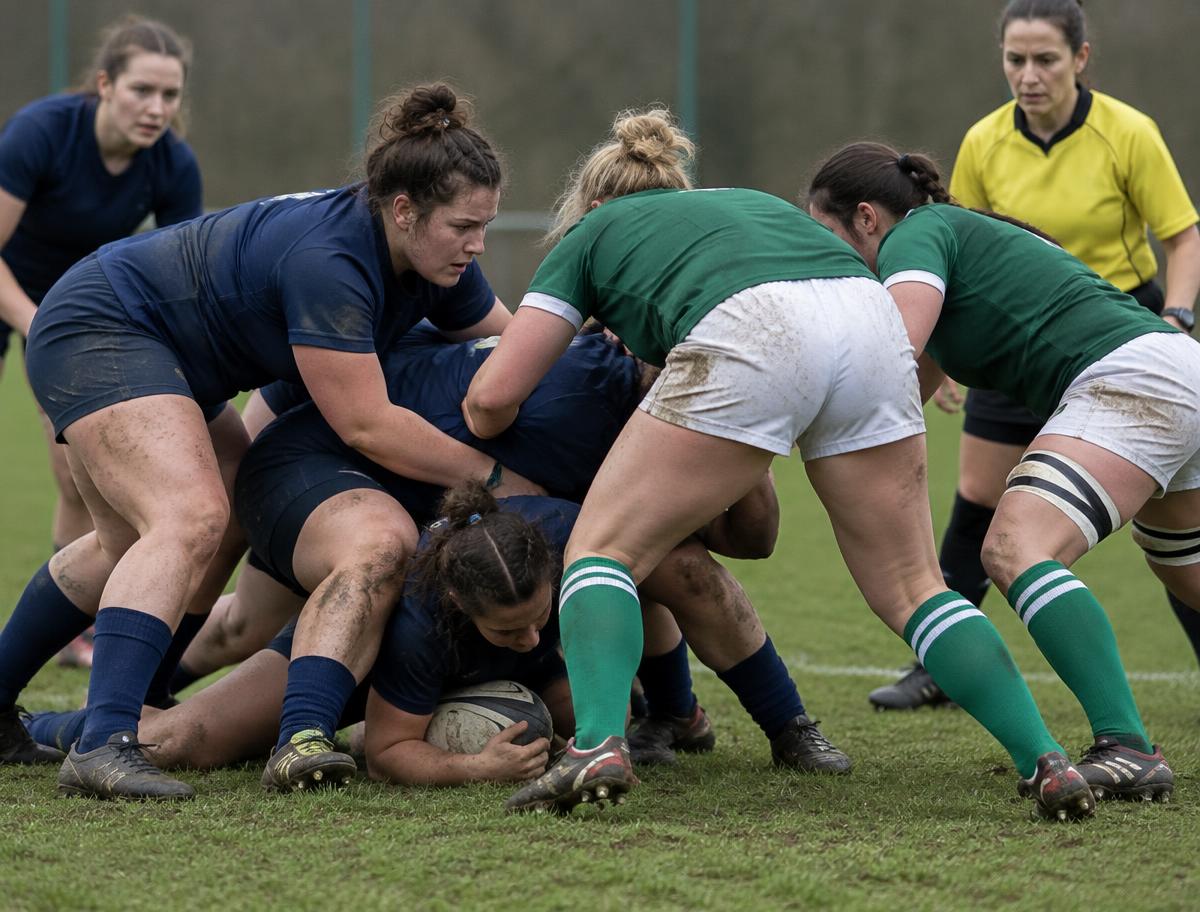
A ball carrier is stopped and brought to ground. Teammates and opponents rush in, a short physical contest follows — and the referee awards a penalty. To understand that decision, it helps to watch not only the ball but the sequence of actions: who released the opponent, who stayed on their feet and when the ruck was formed.
The tackle is not the end of the passage
Under the laws, a tackle occurs when the ball carrier is held and brought to ground. The player does not need to be lying on the grass: having at least one knee on the ground while still held is enough.
Both sides then have obligations. The tackled player must immediately make the ball available. The tackler must release the player and the ball, move away or get up, and be on their feet before trying to play the ball again.
That is why holding on to the ball at all costs does not always help the attacking side. If a player on the ground keeps hold of it and prevents a fair contest, the referee can penalise her team. Equally, a defender has no right to lie on an opponent and block the ball simply because she made a successful tackle.
When a ruck is formed
A ruck is formed when at least one player from each team, on their feet, are in contact over the ball on the ground. It is a distinct phase of play, not just another name for any pile of players after a tackle.
Once a ruck has formed, players may not use their hands. The exception is a player who legally got hold of the ball before the ruck formed and remains on her feet.
This creates an important nuance for viewers: two similar-looking attempts to win the ball can be judged differently. In one, the defender started the contest earlier; in the other, she reached in after the ruck had formed. On the replay, look for that moment rather than simply who was stronger.
Why you cannot join from any side
A player joining a ruck must stay on her feet and enter from behind her own offside line, which runs through the hindmost point of her team's players in the ruck. She must also bind onto a teammate or opponent rather than simply crash into the group.
So the shortest route to the ball is not necessarily a legal one. Going around the side of the ruck may bring an instant advantage — and end with a penalty.
A ruck and a maul are not the same
The key difference is the position of the ball. In a ruck, the contest happens over the ball on the ground. In a maul, the ball is held off the ground and the ball carrier is bound to at least one teammate and one opponent, with everyone on their feet.
Next time you watch a match, try a simple approach: after each tackle, first follow the actions of the two original players, then the first player to arrive. This sequence helps you spot the reason for the whistle before the camera shows the referee's signal.